

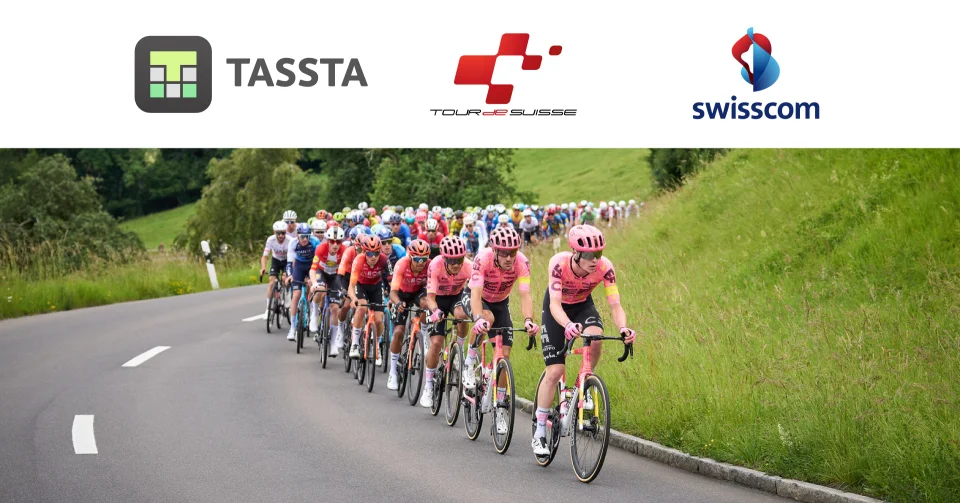
Why the upgrade was needed
-
In the years before 2025, major tragedies — notably the death of Gino Mäder (at the 2023 Tour de Suisse) and Muriel Furrer (in a 2024 world championship crash) — exposed glaring safety gaps in pro cycling: specifically, delayed detection of crashes, difficulty tracking riders, and limited situational awareness for race organizers and emergency services.
-
-
Organizers recognized that traditional methods (manual observation, radio, limited coverage) were insufficient — especially in mountainous terrain or remote areas of the route — and committed to a radical rethink of safety protocols.
What Swisscom + TASSTA implemented in 2025
— Multi-layered tracking & real-time communication
-
Every competitor’s bike — as well as all accompanying vehicles (the “convoy”) — was fitted with a small GPS tracker.
-
The tracking system was configured to trigger alerts under specific conditions: e.g., if a tracker remained still for more than 30 seconds, recorded a sudden change in speed, or deviated off the pre-planned route.
-
All data (GPS signals, location of riders and convoy; TV broadcast feeds; a weather radar; pre-mapped hazard zones) are funneled into a brand-new mobile safety control centre — essentially a “command hub” for security staff overseeing the race.
— Digital Push-to-Talk communications replacing analogue radio
-
Using Push-to-Talk over Mobile (PTToM) technology delivered by Swisscom + TASSTA, the race replaced the old analog radio network with a fully digital system. This allows seamless communication across diverse devices: smartphones, tablets, traditional radios — and integrates all event personnel, from marshals to convoy drivers to media control.
-
Roughly 400 devices were deployed this year across the race — covering all key stakeholders.
-
Because the system runs over the Swisscom mobile network — which covers ~99% of the population and offers robust coverage even along remote Swiss roads — there is less need for temporary infrastructure or radio towers.
-
Importantly: in case of network congestion, push-to-talk devices get priority, guaranteeing communication remains operational.
— Pre-race hazard mapping and coordination
-
Ahead of the race, all routes were analyzed and potential danger spots were marked in a digital mapping system (using Velo Viewer), which was accessible to all participating teams. This ensured every team was aware of risk zones before and during the event.
-
The safety center — watching GPS, video feeds, weather radar — was staffed by a small dedicated team (three people during the race) who monitored for any incident and could dispatch help immediately.
What changed — and what this “transformation” actually achieves
-
The 2025 Tour de Suisse became the first professional cycling race in the world to deploy a full rider + convoy tracking system combined with a dedicated mobile safety centre.
-
This increases real-time situational awareness: organizers and safety staff now have live data on where every rider and support vehicle is, allowing them to detect crashes or irregularities (e.g., sudden stop, deviation) immediately.
-
With the new Push-to-Talk digital network, communication is faster, more flexible, and not dependent on legacy radio infrastructure — which often had coverage gaps.
-
Pre-identified hazard zones + coordinated convoy tracking significantly improve risk management — offering advance preparation, allowing rapid response, and ensuring that no rider is “out of sight.”
-
Overall — very importantly — organizers and commentators note that while no system can guarantee “zero risk,” this integrated approach “minimizes consequences” and “gives all the information we can give teams” to act quickly if something happens.
Broader significance: What this means for cycling moving forward
-
The implementation by Swisscom + TASSTA at Tour de Suisse sets a new benchmark for race safety: other races (Grand Tours, Classics, national tours) may now feel greater pressure or encouragement to adopt similar safety infrastructures.
-
The fact the governing body UCI publicly welcomed the initiative signals that “smart safety & tracking” may become more standard — particularly as they explore rolling out tracking at world championships.
-
Having real-time GPS + communication + hazard-mapping infrastructure also offers potential beyond crashes: better coordination of support vehicles, quicker reaction to bad weather or road hazards, improved logistical coordination — ultimately smoother, safer races.
-
Finally, it helps re-balance what historically has been an “accept risk” sport. With technologies like this, the culture around rider safety may shift — and stakeholders (teams, organizers, fans) will likely expect more responsibility and protection going forward.
Limitations & What Still Can’t Be Fixed
-
The system doesn’t — and cannot — prevent all crashes. It can only detect incidents once they happen (or are about to happen) and speed up the response. As the organizers put it: “There is no such thing as absolute safety.”
-
Some thresholds (e.g., 30 seconds of no movement, sudden speed change, deviation) may trigger false alarms — especially in mountainous terrain where GPS/ signal issues or natural breaks may look abnormal. According to safety-center staff, part of 2025’s implementation was “learning in hot operation.”
-
Because participation was voluntary for teams (though all teams opted in in 2025), this kind of system might face resistance in other races or under different regulations — especially if teams are worried about data privacy, competitive data leaks, or regulatory oversight.
Conclusion: A Major Step Forward — and a Template for the Future
The collaboration between Swisscom Broadcast and TASSTA at the 2025 Tour de Suisse didn’t just tweak existing safety protocols. It reimagined the entire safety infrastructure by combining real-time GPS tracking, digital communications, hazard mapping, and a centralized safety command center — all with the explicit goal of protecting riders.
While no technology can eliminate the inherent risks of high-speed professional cycling — especially on technical or dangerous courses — this multi-layered system does significantly raise the bar. More than that: it provides a working template for future races worldwide.
If you like, I can check which other major races (Grand Tours / World Tour events) are now considering or already adopting similar safety frameworks — to see whether this becomes an industry standard. Do you want me to build that list for you now?
